



For importers shipping goods from China to Russia or other international destinations, poor packaging can lead to damaged cartons, broken pallets, scratched metal parts or products arriving in a condition that makes them difficult to sell or use.
The problem is not always the transportation itself. Sometimes, the damage starts before the truck leaves the warehouse.
So, how should cargo be prepared for international road transport? The answer depends on the type of goods, their weight, dimensions and how they will be loaded inside the truck.
There is no single packaging method suitable for every shipment. A carton of electronic accessories and a pallet of industrial metal components have very different transportation requirements.
Before arranging a shipment, importers should consider the following options.
Cardboard cartons are widely used for general commercial goods, including household products, accessories, clothing and smaller industrial components.
However, ordinary retail packaging may not always be strong enough for long-distance transportation.
For international road freight, consider:
Using strong, multi-layer corrugated cartons for heavier products.
Avoiding excessive empty space inside the boxes.
Adding cushioning materials around fragile items.
Sealing cartons securely with suitable packing tape.
Keeping carton sizes consistent where practical to simplify palletizing.
One common mistake is putting heavy products into oversized cartons without enough internal support. The contents can move around, increasing the risk of damage even when the outer box looks intact.
Wooden crates are often a better option for machinery parts, precision equipment and products that require additional external protection.
Unlike ordinary cardboard boxes, a properly designed wooden crate provides a more rigid structure and helps protect cargo from external pressure and handling impacts.
For heavy industrial goods, the crate should be designed around the actual weight and dimensions of the product.
Importers should also check whether wooden packaging needs to comply with applicable international phytosanitary requirements, including ISPM 15.
More information is available from the International Plant Protection Convention (IPPC).
Pallets make cargo easier to handle with forklifts and help organize goods inside a truck.
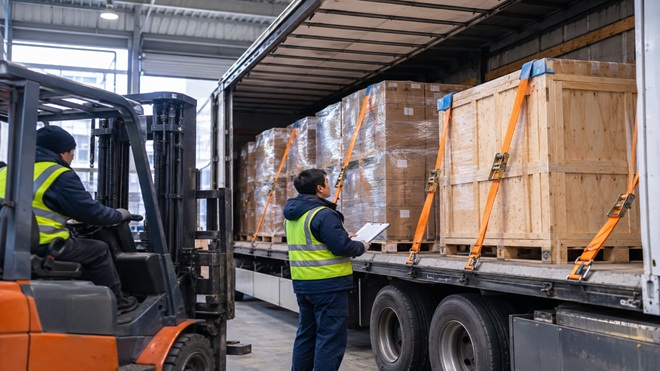
They are particularly useful when a shipment contains multiple cartons, bags or smaller packages.
However, putting cartons on a pallet does not automatically make the load secure.
A suitable pallet should:
Support the total weight without bending or breaking.
Be large enough to support the cargo base.
Keep the goods stable during forklift handling.
Allow the cargo to be secured with stretch film or suitable straps.
For mixed shipments, grouping similar goods onto separate pallets can also make loading and unloading easier.
Packaging protects individual products, but cargo securing protects the entire load.
This is particularly important in international road transport. Trucks encounter acceleration, braking, cornering and changing road surfaces throughout a long journey.
Even when a pallet looks stable at the warehouse, insufficient securing can allow it to shift once the vehicle is moving.
Several methods can help reduce this risk.
Stretch film is commonly used to hold cartons together on a pallet.
It helps prevent individual packages from separating and provides an additional layer of protection against dust and light moisture exposure.
For better results, the film should secure the load to the pallet rather than simply wrap the upper cartons.
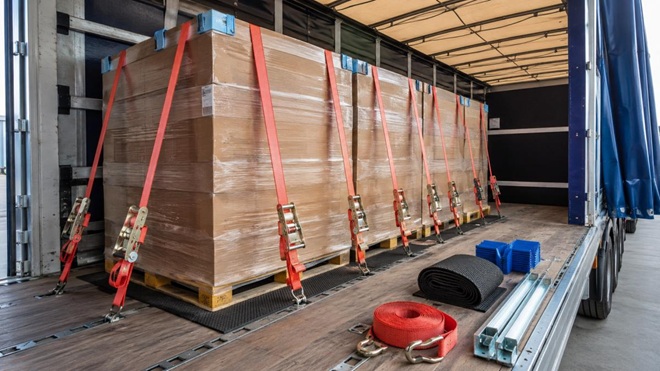
Ratchet straps are used to secure cargo to suitable lashing points inside the truck.
They are especially useful for heavier pallets, industrial components and other cargo that requires stronger restraint.
The straps should be selected according to the load and securing arrangement. Protective corner pieces can also help prevent strap pressure from damaging carton edges or sensitive surfaces.
Some goods have sharp edges, uneven surfaces or packaging that can be easily crushed.
Edge protectors help distribute strap pressure and reduce damage to packaging.
Anti-slip mats can increase friction between cargo and the loading surface, helping reduce movement.
The correct combination depends on cargo weight, shape, packaging and the vehicle.
The IRU Safe Loading and Cargo Securing Checklist provides practical guidance on choosing securing methods, checking lashing equipment and distributing cargo weight.
A shipment can be properly packaged and still create problems if it is loaded incorrectly.
This is particularly relevant for dense products such as steel components, building materials, machinery parts and other industrial goods.
For example, placing too much weight in one section of a truck can create an uneven axle load, even if the total cargo weight remains within the vehicle's permitted limit.
During loading, attention should be paid to:
The total weight of the shipment.
Weight distribution across the vehicle.
The position of heavy and lightweight packages.
The stability of each pallet or crate.
The planned unloading sequence.
Heavy goods should generally be placed at the bottom, with lighter goods above them where the packaging and stacking arrangement allow.
Importers should also avoid stacking fragile packages beneath heavy cargo simply to save loading space.
The IMO/ILO/UNECE Code of Practice for Packing of Cargo Transport Units (CTU Code) provides further guidance on cargo packing, weight distribution and securing for transport by land and sea.
Different types of cargo face different risks. Understanding these problems before dispatch makes it easier to choose suitable packaging.
Industrial metal components
Metal parts can scratch each other when they are not separated properly. Bolts, fittings and other hardware should be packed to prevent repeated contact during transportation.
Furniture and bulky products
Furniture may have large surfaces that are vulnerable to scratches, pressure and corner damage. Protective wrapping, corner guards and suitable internal cushioning are important.
Fragile products
Glass, ceramics and other breakable goods require internal cushioning as well as strong outer packaging. Simply marking a carton as "Fragile" is not enough.
Palletized cartons
Poor stacking or insufficient wrapping can cause cartons to lean, collapse or separate from the pallet.
The key is to consider the entire journey, not just the conditions inside the supplier's warehouse.
DR Trans has handled different types of commercial and industrial cargo moving from China to Russia.
One example involved the transportation of 22 tons of building hardware from Handan, Hebei Province, to Yelabuga, Russia.
The shipment covered nearly 8,000 kilometres and was delivered door to door in 11 days.
For this particular shipment, the loading process took six hours. Each pallet was secured using heavy-duty ratchet straps, edge protectors and dunnage bags. Shrink wrap was also applied to individual packages to help keep the cargo stable.
Why was this level of preparation necessary?
Building hardware is relatively dense, and metal products can damage each other if they move during transportation. Even small amounts of repeated movement can result in scratches, bent components or damaged threads.
The shipment demonstrates an important point: successful transportation starts with proper preparation at the loading location.
You can read the full case study here:
Hardware Parts Shipped from China to Russia via TIR
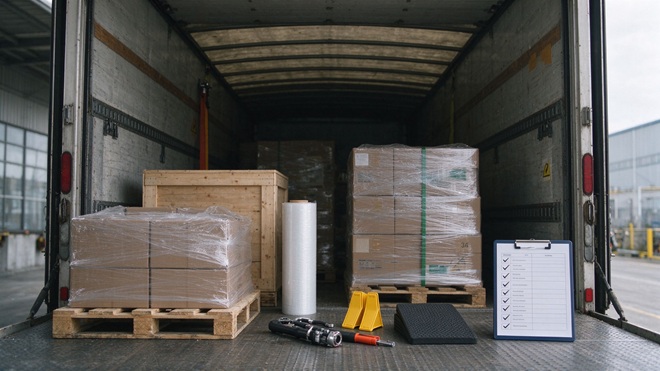
Before arranging international road transport, it is worth confirming a few practical details with the supplier and freight forwarder.
Packaging and cargo condition
Are all cartons, crates and pallets in good condition?
Is the internal cushioning sufficient?
Are fragile or heavy items packaged separately where necessary?
Cargo information
What is the total number of packages?
What are the dimensions and gross weight?
Are there any unusually heavy or oversized items?
Does the cargo require special handling?
Loading and securing
Is the truck suitable for the cargo?
Are the pallets and crates stable?
Are suitable straps and protective materials available?
Is the cargo weight distributed properly?
Transportation arrangements
Is the loading plan suitable for the delivery schedule?
Will the cargo remain on the same vehicle during the planned TIR journey?
How will shipment progress be monitored?
Providing accurate cargo information in advance helps the freight forwarder prepare the right vehicle and loading arrangements.
Proper packaging is only one part of a successful international shipment. The transportation arrangement, loading process and cross-border coordination also matter.
DR Trans provides international TIR road freight services, with a strong focus on China–Russia transportation.
Our services are supported by our own fleet and logistics team, with direct transportation arrangements, customs coordination and cargo tracking.
For suitable TIR shipments, the cargo can travel under a sealed transport arrangement without routine unloading and reloading at intermediate borders. This helps reduce unnecessary cargo handling during the journey.
Depending on cargo type, shipment volume and delivery requirements, our team can help coordinate suitable transportation arrangements for general cargo and industrial shipments.
Learn more about our China–Russia TIR transport services.
Good cargo packaging is not simply about using more cardboard, stretch film or wooden crates. It is about choosing the right protection for the actual goods and making sure everything remains stable throughout the journey.
For importers, a few additional checks before dispatch can help avoid unnecessary damage, handling problems and delivery complications.
If you are planning to ship goods from China to Russia, DR Trans can help arrange international TIR road transportation based on your cargo details and delivery requirements.
Contact DR Trans to discuss your shipment and request a freight quotation.

 IPv6 RED SOPORTADA